
Key considerations when selecting a system
Many issues in the bonding process do not arise during application. They occur during system selection.
Because often the focus is initially on two factors:
- Price
- Availability
Meanwhile, crucial questions remain unaddressed:
- What is the viscosity of the material?
- How frequently is the application performed?
- What ergonomics does the user require?
- How important is process stability?
The consequence:
- inefficient processes
- fluctuating dosing
- unnecessary rework
Successful companies therefore do not only consider the device.
They analyze the entire process – a central concept of Total Cost of Bonding (TCB).
Unsure? “We ensure that your process works – permanently.”
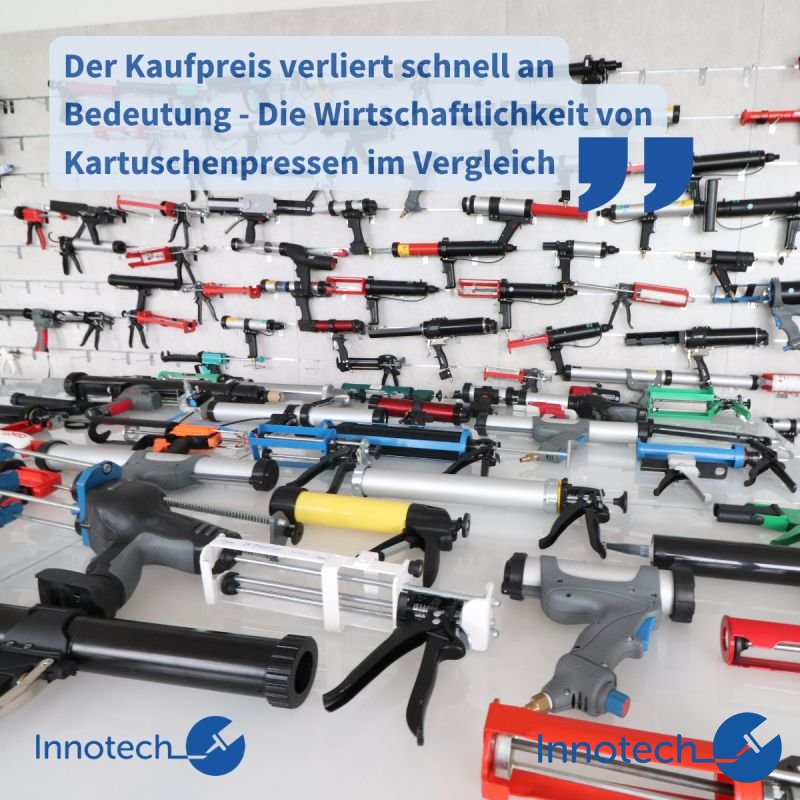
The purchase price quickly loses significance
The purchase price quickly loses significance.
When selecting cartridge presses, the device price is often the first consideration.
However, in practice it quickly becomes clear:
The largest cost factor in the bonding process is not the device – but the processing.
Labor time, dispensing speed, and ergonomics have a significant impact on the actual cost per cartridge.
A simple cost-effectiveness analysis shows:
• Manual devices initially appear inexpensive
• Pneumatic or battery-powered systems are more economical in many applications in the long term
• Actual costs often arise only during the ongoing process
💡 We have examined exactly these relationships in detail in a technical article.
Among other things, we demonstrate:
✔ how to calculate the cost-effectiveness of cartridge presses
✔ when more powerful devices pay off
✔ why break-even analyses help in device selection
✔ the role process stability and ergonomics play
📄 Whitepaper:
“The purchase price quickly loses significance – The cost-effectiveness of cartridge presses compared”
Download now for free
How do you currently make decisions when selecting dispensing systems?
Price – or process costs?