26th Colloquium on Joint Research in Adhesive Bonding Technology
The 26th DECHEMA Colloquium on Joint Research in Adhesive Bonding Technology will once again bring together experts from industry and research in 2026 to discuss current developments, research results, and future trends in adhesive bonding technology.
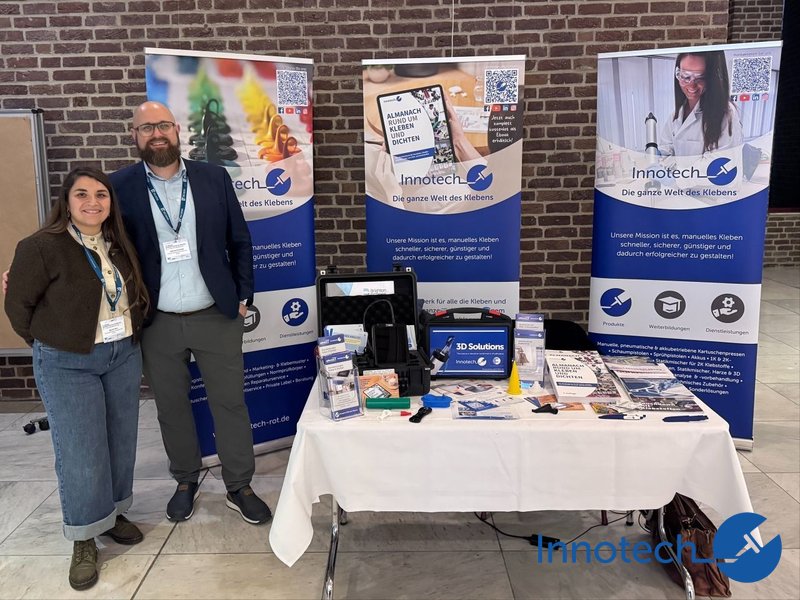
Innotech will also be represented at the event again this year. Our colleagues Buruk Sen and Adrien will be attending the colloquium live and taking the opportunity to exchange ideas with experts from the industry.
As usual, the agenda features high-caliber presentations and in-depth technical discussions.
The core topics for 2026
This year's focus reflects key issues in modern adhesive bonding technology:
- Sustainability
- Aging
- Surfaces
- Manufacturing in vehicle, steel, glass, and wood construction
- Simulation
- Outlook for future research and development
These topics should not be viewed in isolation. They are intertwined and influence each other—both technically and economically, as well as in terms of regulations.
Why adhesive bonding technology only works holistically
From our perspective at Innotech Marketing, it is clear time and again that:
The real added value of adhesive bonding technology arises when different aspects are considered together.
These include in particular:
- Materials
- Surfaces and pretreatment
- Process control
- Component design
- Aging behavior
- Sustainability requirements
Only when these factors are considered together can reliable and economical adhesive bonding solutions be developed. Especially in times of increasing global competition and growing regulatory requirements, this systemic understanding is crucial to remaining competitive in the long term.
Knowledge transfer: Training in adhesive bonding technology
We also impart this holistic understanding in our courses for DVS®/EWF European Adhesive Bonder (EAB) and DVS®/EWF European Adhesive Specialists (EAS), which we conduct in collaboration with Fraunhofer IFAM.
Our focus is not only on theory, but above all on the practical transfer of knowledge that companies can apply directly in their production and development processes.
The combination of research, industrial application, and qualified training is a central building block for sustainable adhesive bonding technology.
A particularly exciting topic: aging
One topic that is currently receiving a lot of attention—and is also of great importance to us at Innotech—is the aging behavior of adhesive bonds.
This is where the interaction between material, surface, process parameters, and environmental conditions becomes particularly clear. Aging ultimately determines whether a bond will function reliably for years or fail prematurely.
On-site exchange
Events such as the DECHEMA colloquium thrive on open dialogue between research and industry.
That's why we're also interested in:
What topics are you currently working on in the field of adhesive bonding technology?
If you're on site, feel free to drop by—our colleagues Buruk Sen and Adrien look forward to exchanging ideas with you.
Frequently Asked Questions (FAQ)
Question: What is the 26th Colloquium “Joint Research in Adhesive Technology” organized by DECHEMA about?
Answer: The DECHEMA Colloquium brings together experts from industry and research to discuss current developments and future trends in adhesive technology. The focus is on new research findings, practical applications, and professional exchange between science and companies. The event promotes knowledge transfer and strengthens collaboration within the industry.
Question: Which key topics define adhesive technology in 2026?
Answer: The central topics in 2026 include sustainability, aging of adhesive bonds, surfaces, manufacturing in various industrial sectors, simulation, and future research. These topics are closely interconnected and influence both technical and economic decisions. They reflect how adhesive technology continues to evolve to meet modern requirements.
Question: Why is a holistic approach important in adhesive technology?
Answer: A reliable bonding solution can only be achieved when materials, surfaces, process control, component design, and aging behavior are considered together. Isolated measures are not sufficient to ensure long-term performance. A holistic approach secures quality, cost efficiency, and competitiveness.
Question: What training opportunities are available in adhesive technology?
Answer: Innotech offers training programs for DVS®/EWF European Adhesive Bonder (EAB) and DVS®/EWF European Adhesive Specialist (EAS). These courses are conducted in cooperation with Fraunhofer IFAM and combine theoretical knowledge with practical application. Participants learn how to plan and implement adhesive processes safely in production.
Question: Why is the aging behavior of adhesive bonds so important?
Answer: Aging behavior determines how long an adhesive bond will perform reliably. Material selection, surface preparation, process parameters, and environmental conditions all interact. A thorough understanding of aging is essential to prevent failures and develop durable bonding solutions.