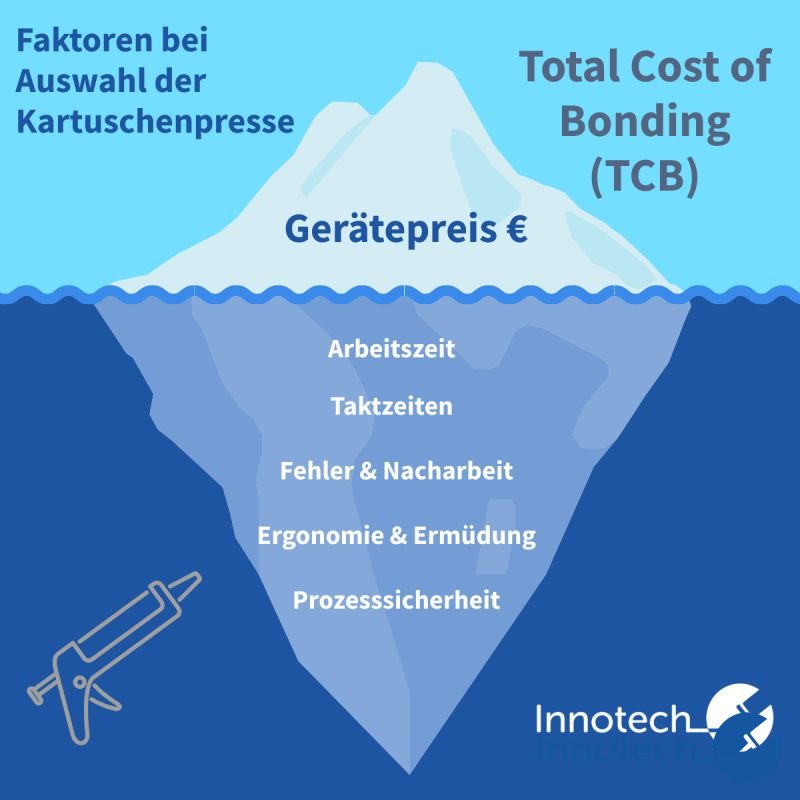
Total Cost of Bonding (TCB)
Most companies make the wrong decision when it comes to bonding.
They focus on the equipment price and overlook the actual cost drivers.
Reality:
The purchase price is just the tip of the iceberg.
The real costs arise here:
- Labor time
- Cycle times
- Errors & rework
- Ergonomics & fatigue
- Process reliability
This is exactly where Total Cost of Bonding (TCB) comes into play:
It’s not the purchase price that matters – but the entire process.
Those who buy cheap often pay twice.
"Are you already considering your entire bonding process – or just the purchase price?" In our European Competence Center Manual Bonding (ECCMB), we make these issues visible and help to sustainably reduce your own TCB.
Frequently Asked Questions (FAQ)
Question: Why is the price of a cartridge press often less important than expected?
Answer: The purchase price of a cartridge press accounts for only a small portion of the total process costs. Much higher costs arise from labor time, errors, rework, and inefficient workflows. Therefore, it is worthwhile to consider the entire bonding process and not just the equipment price.
Question: What costs arise in the bonding process besides the equipment price?
Answer: Besides the equipment price, labor time, cycle times, and potential errors play a major role. Ergonomic strain and lack of process reliability can also cause additional costs. These factors influence long-term profitability more significantly than the pure purchase price.
Question: What does Total Cost of Bonding (TCB) mean?
Answer: Total Cost of Bonding describes the approach of evaluating the entire bonding process. It considers not only material or equipment costs but also time expenditure, quality, and process reliability. The goal is to understand and optimize the actual total application costs.
Question: Why can a cheap device be more expensive in the long run?
Answer: A cheap device can lead to uneven dosing, higher time expenditure, or more rework. These factors significantly increase process costs beyond the initial purchase price. Therefore, an apparently cheap decision can cause higher costs in the long term.
Question: How does the European Competence Center Manual Bonding (ECCMB) help companies?
Answer: The European Competence Center Manual Bonding supports companies in holistically analyzing their bonding process. Factors such as equipment selection, workflows, and process reliability are considered. The goal is to sustainably reduce the Total Cost of Bonding and develop more efficient solutions.